Both Sides of the Treatment Table | EASE OS™ Podcast S1 E01
Nov 09, 2026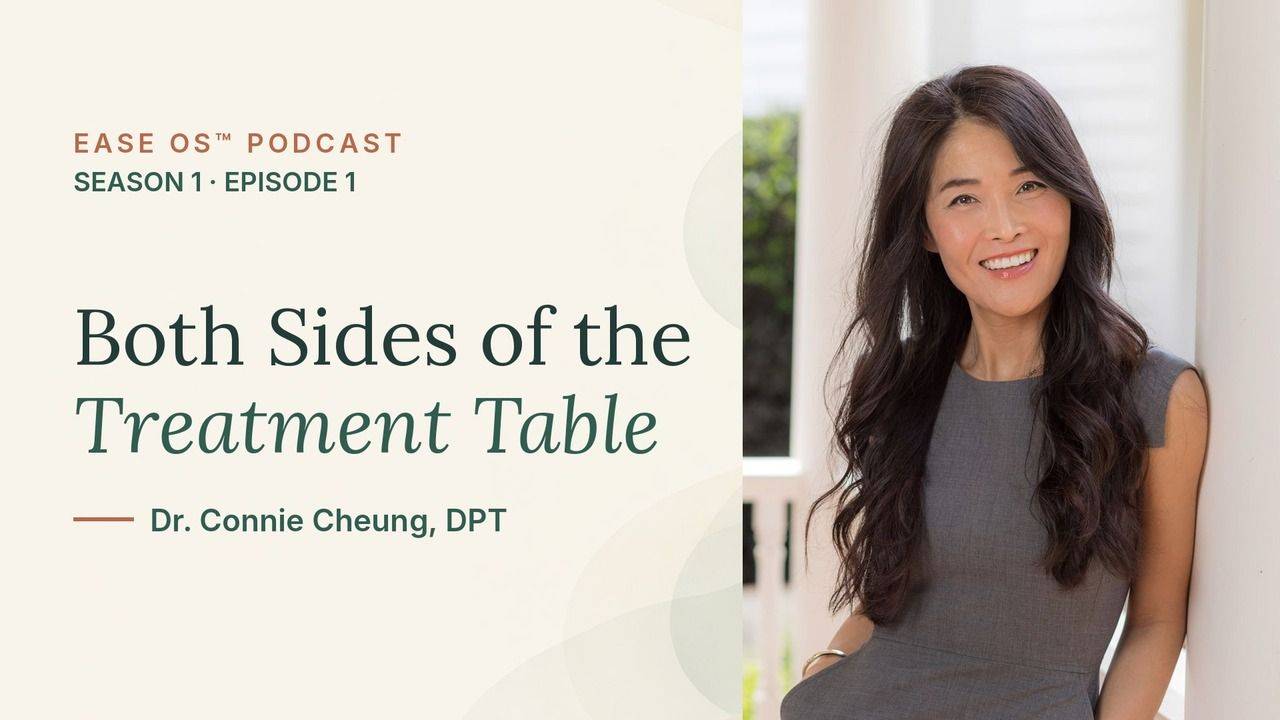
EASE OS™ Podcast · Season 1 · Episode 1
Listen on Apple Podcasts · Spotify · YouTube
In this episode
Dr. Connie Cheung has spent thirty years studying the human body: psychology, nutrition, physical therapy, Pilates, yoga, functional medicine, and years of hands-on manual therapy training. Then she became the patient. Lupus, kidney failure during COVID, dialysis, and two kidney transplants.
In this first episode of Season 1, she shares what she learned on both sides of the treatment table: why every discipline taught her something true but none could answer the questions in between, why popularity doesn't measure quality, and what she calls the Embodiment Gap, the space between knowing about your body and being able to live in it.
You'll hear why posture starts at the core and not the shoulders, how EASE OS™ works as an operating system for the body (four domains, five stages, seven pillars), and a seated practice you can do at your desk, in the car, or standing in line.
Key takeaways
- Where it hurts is rarely where it started. The knee is working for the hip. The neck is doing the core's job.
- Your joints, gut, hormones, and immune system aren't separate departments. They're one conversation, and care is built in silos.
- The Embodiment Gap is the space between knowing about your body and being able to live in it. It's a translation problem, not a knowledge problem.
- Core first. Alignment second. Strength third. Every time.
- Popularity doesn't measure quality. Fit the pose to the person. Don't contort your body to fit the pose.
Feel it · 2 minutes
Sit tall from the inside
- Scoot to the front of your chair, feet flat, hip-width apart. Rock side to side until you feel both sit bones, then settle evenly.
- Breathe in through your nose and let your ribs widen to the sides.
- Breathe out slowly, like fogging a mirror, and gently draw your lower belly in, about a quarter of your effort. Feel a small lift underneath you.
- Keep that gentle hold and let it lift you. The crown of your head floats up. Your shoulders drop on their own.
- Breathe normally and keep about half of that length. Repeat at your desk, at red lights, and in line this week.
Move only within what feels comfortable, and stop if anything hurts.
Start where I started.
The free 15-minute EASE Reset: one guided practice to feel your core, your breath, and your body working together again.
Get the free ResetDr. Connie Cheung, DPT · MPH · RD · FMCP™ · E-RYT 500, is a doctor of physical therapy and the founder of EASE OS™. This podcast is for education, not medical advice. Talk with your own provider about your care.